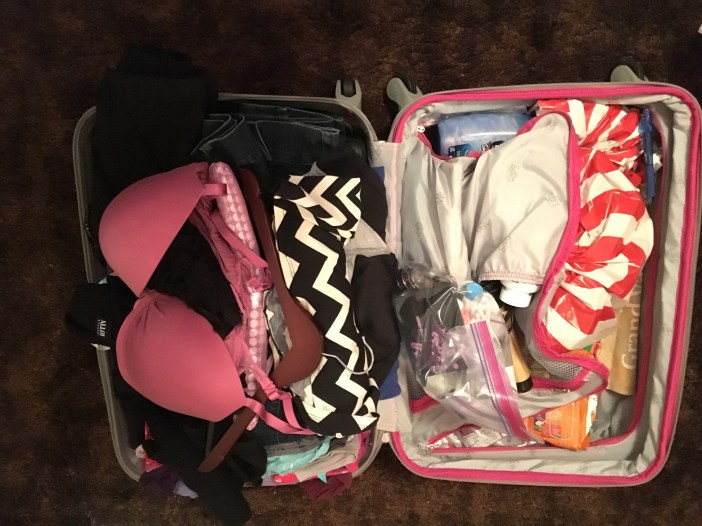
The advice “travel light” is not without merit, but I do recommend considering packing the following items for any extended trip. I was either glad I brought this stuff or had to buy it on the fly.
Hand Fan
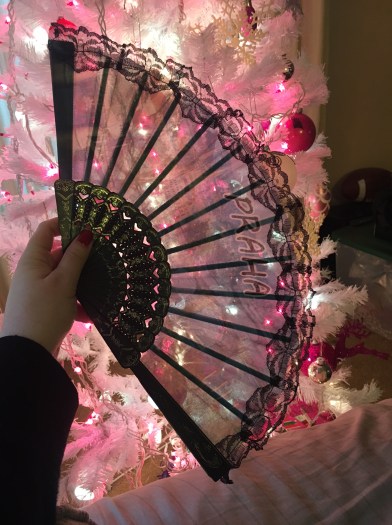 Yes, it rained A LOT during my trip, but there was enough sun and heat to make a spur-of-the-moment purchase of a street vendor hand fan a life-changing event. Even if it’s not that warm outside, walking for miles and hauling your pack around is sweaty work. And buses? Sweaty. Very, very sweaty. A/C is not so much of a thing in Europe as it is here, so you have to make your own wind, just like Tyra Banks intended.
Pocket Mirror
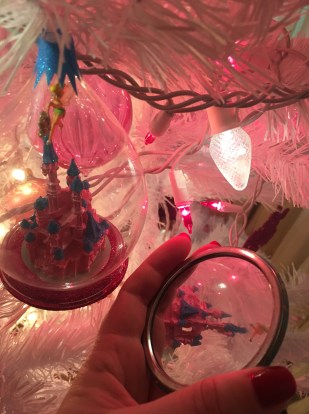
Another golden impulse buy—the pocket mirror saved me from countless embarrassments. Blotting my sweaty face with paper napkins almost always shredded the napkin and left huge pieces of lint fluttering on my face. And with the wind and rain, everyone needs to know what the hell is going on with their hair before they step into a nice restaurant. Also, you can signal people with sunlight if you get bored.
Scarf
 You may have noticed I am not especially fashion minded. Probably this is due to the fact that fashionable clothing is not made in my a) size or b) budget, so I have given up and wear basically the same thing every day. Yes, I brought six identical black tank tops to Europe. Not having to worry about putting together an outfit only gave me more time to explore and eat new foods. I brought a scarf, but it wasn’t an infinity scarf and kept falling off. I gave up on it and bought an infinity scarf from a street vendor at the gay pride event in Hamburg. Dad loved shopping there so it was extra special. My advice, bring one or two infinity scarves to change up your wardrobe. They won’t fall off and you’ll look at least slightly different in your pictures. Plus, they are light and easy to pack.
Umbrella
Invest in one that won’t turn inside out and backwards. I never found one.
Dry Shampoo
*Cue the Hallelujah music* Dry Shampoo! If you haven’t already joined the dry shampoo revolution, you have a wonderful surprise in store. You do not have to be a slave to long showers and the hairdryer anymore. I use this brand, which I recommend if you can stomach the price. This brand is less expensive and nearly as effective, though dry shampoo in general can smell and feel gnarly. Try a few out before you decide what works for you. If the first three or four do not work—DO NOT GIVE UP. There are loads of options, and the time and energy saved by using dry shampoo cannot be overstated. Still not convinced? Observe the picture above. That’s 4th or possibly 5th day hair. This is my life now. I can’t imagine getting up an hour earlier every day to wash, condition, gel, mousse, protect, dry, then curl my hair. Forget it.
Eye shade
I am a napper, so using an eye shade is nothing new to me. I used an eye shade on the plane and a few trains, but it mostly came in handy in my actual Airbnbs as I was trying to sleep at night—it stayed lighter A LOT later in northern Europe and it screwed up my sleeping schedule (go to sleep early and sleep in as late as possible). This particular shade has convex areas for your eyelashes so you don’t wake up with bedhead on your face.
Pocket Kleenex
This one is probably pretty obvious, but I went through a lot more Kleenex than I thought I would. Pack triple what you think you need. I ended up using this not only for sneezes, but for napkins, blotting paper, and toilet paper.
Handkerchief
I had my dad bring me an actual handkerchief because I was going through so much Kleenex just blotting my face. A handkerchief is greener, classier, and won’t leave lint all over your lip hairs.
Benedryl
So they don’t have the same drugs in Europe. For over the counter stuff, bring what you like to use, but also bring Benedryl. You never know what exciting new pollen you’ll be allergic to, and Benedryl can double as a sleep aid.
Books
I brought The Stand and Daisy Miller and Other Stories knowing I’d trash them or leave them behind as I finished them. The Stand was very satisfying to finish because it cleared up so much room in my bag. Bring a few paperbacks you know will be entertaining but not lifelong companions. I bought a few books while on the road, too, trying to keep this same philosophy.
Things I Thought I’d Use But Didn’t
Compass
I brought a small compass, but I used the compass app on my phone almost exclusively. I forgot I even had a real compass.
Reusable Water Bottle
I was gung-ho to go green and use this collapsible water bottle, but ultimately it just made more sense to reuse regular water bottles, and then recycle them when they became unwieldy.
Bungee
Several travel blogs suggested this adjustable cord to help you hang your laundry, but I never needed it. The Airbnbs always had a rack or a lot of closet space where I could hang things to dry.
Earplugs
I am an earplugs advocate, and even though there were some loud nights, I didn’t like using the ear plugs when I was travelling—I wanted to be alerted to the noises around me. The exception was when Dad and I shared a hotel room. He snores. A lot.
Inflatable Travel Neck Pillow
I love the idea of this pillow and used it on my redeye from SFO to Madrid, but I never really fell asleep. The pillow shifts ever so slightly as you finally relax your neck on to it, even when the pillow is secured in front. It’s just not that comfortable. I do like that I could deflate it to take up less space in my bag, though, and for that reason alone it is superior to other U-shaped travel pillows.
Take what you will from this. Remember, whatever you packed is what’s going with you.
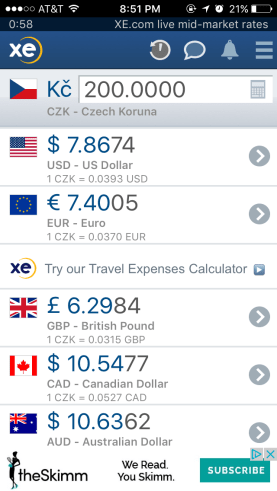 I’m an English major, you do the math. But really, who can convert currencies all the time? Even given the EU, I used five different currencies as I travelled, and this app helped give me an idea of how much 200 Czech korunas is in real money or what to expect once I change my folding money at the exchange booth at the airport (hint: don’t do it there) (hint II: no one wants your coins, so spend them all before you leave the country or end up with ziplock sacks full of foreign coinage like me).
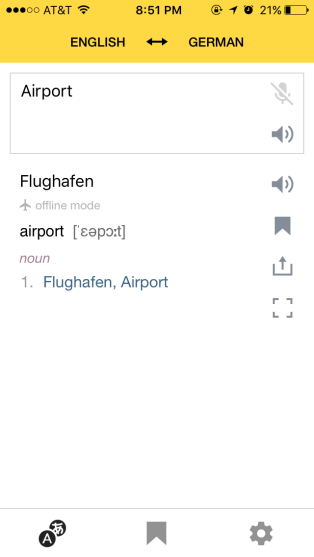 Also like me, maybe you don’t speak any language other than English. There are a quadrillion translation apps out there, and a lot of them are terrible. The most useful one I found is Yandex Translate, which helped with French, German, Dutch, and Spanish. These are just the languages I used—there are loads others. Download the languages you’ll be using and you can translate from there to English and back. It was useful to review some basic words on the train before I arrived somewhere—please, thank you, hello, goodbye, and English were about all I could handle—but people seemed to appreciate even that small effort. Most of the people I encountered spoke at least a little English, but it can’t be taken for granted that wherever you go, people will know what you’re saying. This app was also ace at helping me translate street names, words on menus, and directions. The other two translation apps I used are Google Translate and iThinkdiff Czech Dictionary.
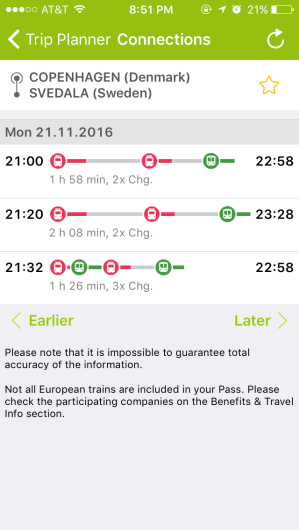 Of all the apps, this one was probably the most crucial to the success (… er, completion?) of my trip. This is the app Interrail and Eurail users are advised to download to track and plan train times, and it doesn’t require wifi. You don’t have to actually have a Eurail pass to use this train app, so if you are just looking to ride the rails one day, this is still for you; just throw in your starting point and ending point, date and time of travel, and get the relevant train schedules. Now, this was NOT helpful when the trains were on strike. Also, you cannot buy or reserve train tickets via the app (so, so annoying). Because of this, you have to do a reality check about whether the trains are a) actually running and b) sold out. It gave me a ball park idea about my schedule though, and what to aim for when I went to the long distance/international tickets booth at the train station to reserve tickets. If the clerk didn’t speak English (common, though Eurail would have you believe otherwise—bleg!), I could easily bring up the schedule I wanted on the app for the clerk to view. If there was no room on that train (uncommon but it did happen), I could easily modify my search to a slightly different time and have the clerk check again. You could also filter results by direct trains (no layovers) and view which trains were high speed. Another feature I didn’t notice at first was that once you select a schedule, you can view each stop between your departure and destination. This was helpful to me because I like to watch each stop go by and confirm and double confirm that I am indeed on the right train. You may call this a bit obsessive, but it helped when my father put us on the fast track to the north pole on accident. I was able to confirm and double confirm that he was totally wrong and then find another train. I was in charge of all trains from then on. Also, this app includes long distance bus schedules.
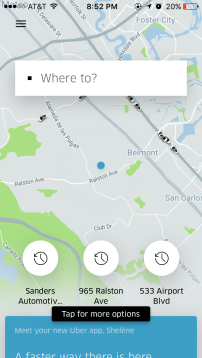 Uber is not a company I want to exalt, but for sheer convenience sometimes it can’t be beat. When you don’t speak the language, calling a taxi is even more intimidating than usual. With Uber, you can type in your destination (or paste it from Yelp) and wait for your ride. Now, Uber only works if you have wifi at the pick up point, so you might have to find a Starbucks or McDonald’s to start from. But after a long day of walking, sometimes you just want to Uber your ass back to your hotel/Airbnb/friend’s couch. Now, Uber does not operate everywhere. Uber was banned in Germany during my time there, and the articles I read about it suggested using MyTaxi app instead. BEWARE! You have to have wifi at both the pickup AND drop off locations. I didn’t have wifi at my drop off location, which happened to be a park, and I had to pay in cash on the spot—not what I had planned! People always say “don’t carry a lot of cash” but honestly had I not always been carrying a significant amount of money with me, I would have been screwed several times (credit card getting declined, restaurant not accepting any credit cards, etc.).
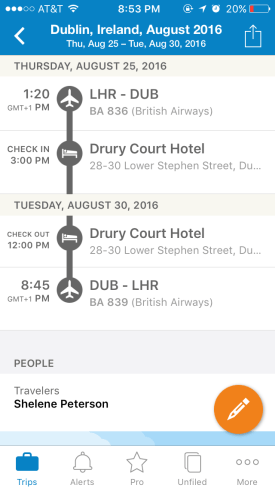 I read about Tripit while researching what apps are good to have as you travel. I ended up purchasing the pro version of this app—something I almost never do. TripIt is an itinerary organizer. You forward your confirmation emails (flight, hotel, airbnb, event tickets) to
 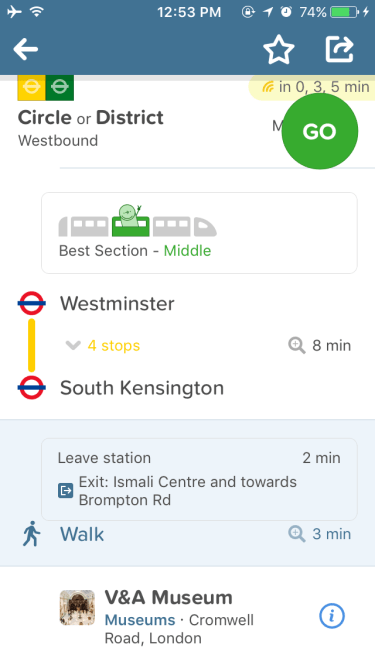 For getting around in London, City Mapper is the app to use. It has other cities as well, but I used it only for London, and it helped me navigate the buses and underground. Like Rail Planner, you can put in your starting and ending points and get suggestions for how to get there. London is HUGE, so be prepared to take a bus to the underground to another bus to another bus, but all the while you can track your progress on City Mapper. Wifi is needed though, so I took a screen shot of the route to refer to. Also, you have to have an Oyster card to ride the bus, so look into how to get one of those before you hop on a double decker. Individual tickets for the underground can be purchased at ticket kiosks though, so go nuts, but mind the gap.
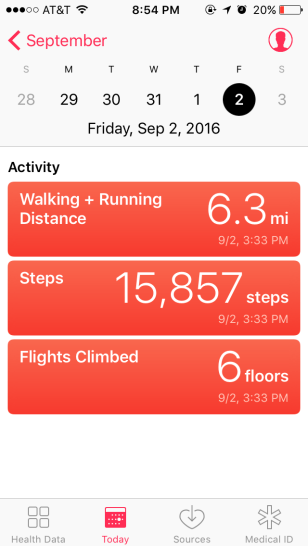 There’s an app that comes with the iPhone that is called “health” and has a heart icon. This was fun only in that it tracked how far I walked. At first it was interesting to see what a change it was from my real life, but eventually I learned that after six miles, I was pretty much done, so I could make decisions on where I wanted to go based on how far I’ve come, and at what point I will poop out. Know your limits and all that.
 I occasionally used Lonely Planet Guides for ideas on what to do. Many times there were things not mentioned by TripAdvisor or Yelp, notably Faust House in Prague, but mostly this app would be useful to someone planning far in advance. My on-the-go day-by-day w-t-f planning didn’t dovetail with the lay out of this app, though it is very pretty and informative.
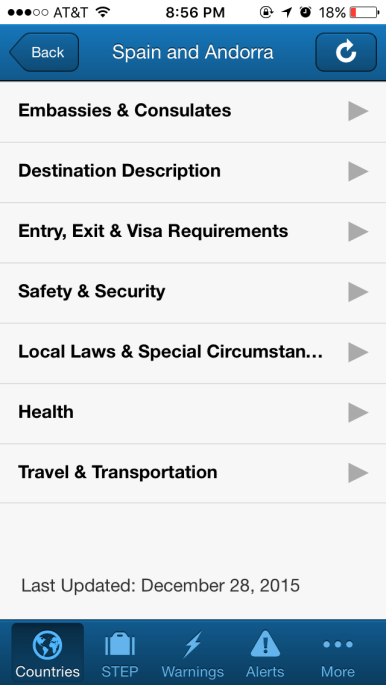 This is an app probably put out by the US government to help Americans as they travel. You select a country and then can find the embassies and consulate offices there along with safety information. It is a very dry read. I considered using it once when I thought I might have to contact my embassy when my debit card got stolen, but thankfully I didn’t have to handle it that way. It’s not a bad app to have, just in case.
 How annoying is Rick Steves? I listened to several podcasts from this app before I left, but found them lacking in both entertainment and informational value. Maybe if you have loads, and I mean loads, of time to plan, you can slash your way through all these podcasts, but reading his Europe through The Back Door was more than enough. He sounds like a morning person who has never been delayed by a hair emergency. I just can’t deal with that type of person.
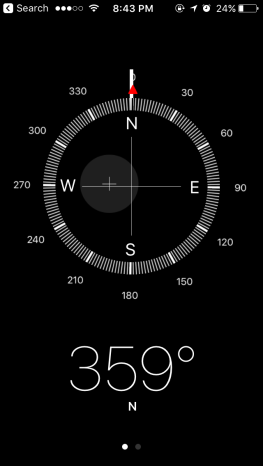 There is an app called “Compass” and it is just that—a digital arrow pointing north. I used this all the time to orient myself before I set off. I very much want to know in what direction my accommodations are in relation to a large landmark if possible, and this free app never failed, with or without wifi.
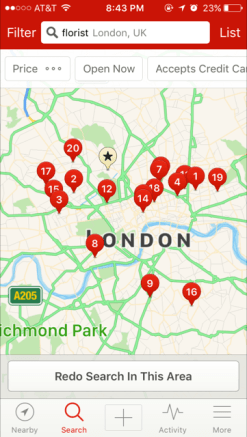 Again, you probably already use Yelp on your phone. Now, without wifi Yelp can be pretty useless, but if you have time before you are out and about, you can plan your snack stops based on the map function on Yelp’s bookmarks page. Bookmark the places you want to visit—Yelp has basically everything—and then view your bookmarks in map form rather than list form. Note the addresses and you can plug them in to Google maps while you’re out for specific directions. Bam, done. The only city that did not have Yelp was Riga, Latvia, but that’s okay because there was
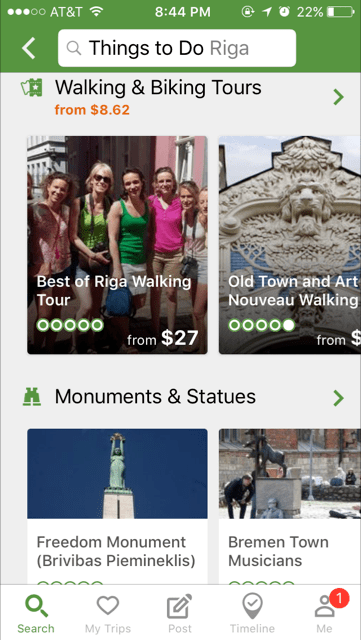 TripAdvisor is like Yelp’s older brother who’s been working on his PhD for over a decade and knows a metric ton of stuff if you just know what to ask. TripAdvisor was a great complement to Yelp and many times had more specific reviews, particularly for hotels. You can filter the reviews by key word (mine were always “wifi,” “noise,” “safe,” and “clean,” if you don’t know how I roll already) and also read the responses from the hotel staff. TripAdvisor has great lists of things to do in each city. After the first page or two of obvious choices—Eiffel Tower, Notre Dame Cathedral, Louvre—you get a lot of info on the different types of tours available. This was useful to me when I was trying to figure out how to get to Stonehenge from London. Had I not used TripAdvisor, I probably would have just taken a bus from the tourist office and saw only the henge. As it turns out, I found a tour that included Avebury, which was just as special as Stonehenge and sort of on the way. TripAdvisor requires wifi though, so do your searching at night when you’re in your
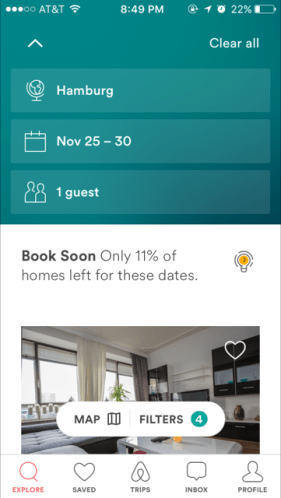 The Airbnb website and app can be convoluted, so spend some time learning the filters and pages before you’re on the road. The app helped with communicating with my hosts, though a lack of wifi can interfere with that. Overall, using the app was far easier than the website for quick emails to my hosts—and I found myself doing that at least once per stop. Note: with only one exception, my Airbnb accommodations had MUCH BETTER wifi then hotels. The trade off is you can leave the hotel room a total disaster, but you better clean up and wipe down everything before you leave an Airbnb.
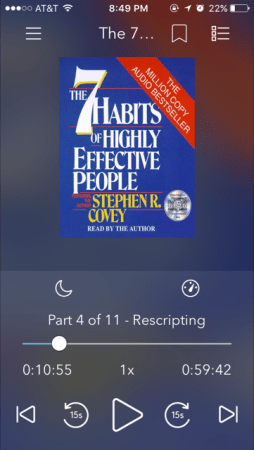 Overdrive is a audiobook app (like Audible) that connects to your existing library card (unlike Audible). Once you download Overdrive and sign in with your library card information, you can access the library’s catalogue of audiobooks (and ebooks, if you are an alien and can read whole novels on a screen) for free. Both Overdrive and Audible require wifi to search and download new material, but once you download a book, you don’t have to have wifi to listen to it. Audible is a monthly subscription service for audiobooks—for a fee you can download one book per month. If you want more, you can buy individual books in addition to your monthly allotment. I cancelled Audible for the duration of my travels, so I didn’t pay the monthly fee but could still access the books I had already paid for. I had several to choose from, and, with Overdrive, was able to listen to many books as I rode the rails or waited for buses. I listened to music as well, but the majority of the time I listened to audiobooks. I have the Kindle app and occasionally read through the chapter of Rick Steve’s Europe Through the Back Door relevant to my next destination, but I don’t like reading ebooks and could do this in short doses only. Also, Rick Steves is annoying.
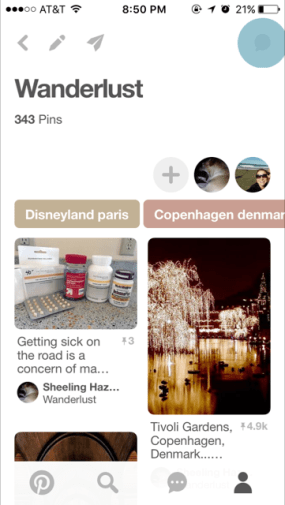 If you already like Pinterest, you are going to love it when you travel. I made Wanderlust board and throw all sorts of ideas on it before I left. Pinterest is great for finding travel bloggers who have very specific suggestions (“9 Free Things to Do in Dublin!”), including where to get gooey chocolate cookies in Amsterdam (Van Staple Koekmakerij, if you’re interested). Using Pinterest in conjunction with Yelp, TripAdvisor, and Google maps helped me figure out my day plan based on what food I want to eat—err and the famous places I might want to take pictures of. The bloggers of the internet can be hard to filter, but Pinterest helps. If you don’t already love Pinterest, it can be a hard app to learn on the go if it’s not your jam. Stick with Yelp and TripAdvisor.
 Keeping in contact with people is dicey on the road. Most of my contacts have Facebook and by extension Facebook Messenger, so this was a natural choice. With the exception of Lil Bro, who is too low key for Facebook and preferred to use Viber, I checked in with everyone using FB messenger. It’s easy and probably most people you’re going to send 3AM humble brags to already have it.









 paralyzedbynotcaring